
AI-Powered LMS: How Connecting GPT, Gemini, and Claude Can Transform Employee Training
Organizations are generating more knowledge than ever before. Policies, training manuals, product documentation, compliance requirements, onboarding guides, and internal processes continue to grow. Yet many employees still spend valuable time searching for answers, repeating mistakes, or waiting for support.
Traditional learning management systems help organize training content, but they often rely on static courses and manual updates. As workplaces become more dynamic, learning platforms need to become more intelligent.
This is where artificial intelligence is changing the way organizations approach learning and development.
By connecting AI models such as GPT, Gemini, and Claude to an LMS, businesses can move beyond content delivery and create learning experiences that adapt, guide, and support employees in real time.
The result is faster onboarding, smarter training, improved compliance, and a more efficient workforce.
Why Traditional LMS Training Has Limitations
Most LMS platforms are designed to deliver content and track completion. While this works for structured learning programs, it does not always support the way employees learn on the job.
Employees often need answers while performing tasks, not days after completing a course. They may need help understanding a policy, finding a process, or learning a new skill at the moment of need.
When information is difficult to access, productivity slows down. Teams spend more time searching and less time executing.
AI helps bridge this gap by making learning available exactly when and where employees need it.
Turning Your LMS Into an Intelligent Learning System
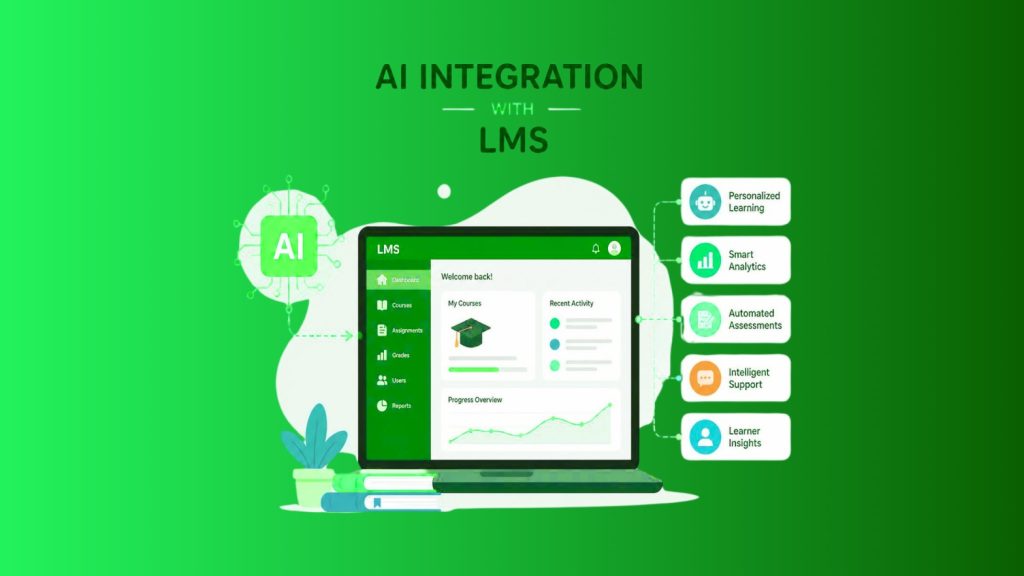
AI integration allows an LMS to do more than store courses. It can analyze learning behavior, generate content, answer questions, and identify skill gaps automatically.
Instead of creating the same learning experience for every employee, organizations can provide personalized guidance based on individual needs and performance.
This shift transforms the LMS from a course repository into an active learning assistant that supports employees throughout their workday.
Deliver Personalized Learning at Scale
Every employee starts with different skills, experiences, and learning preferences.
Some learners may require foundational knowledge, while others need advanced training. Delivering the same content to everyone often leads to disengagement and wasted learning time.
AI can analyze learner progress, assessment results, and activity patterns to recommend relevant content, adjust learning paths, and prioritize the most important skills.
This creates a more personalized experience without increasing administrative workload.
Employees receive training that matches their needs, while organizations improve learning effectiveness across larger teams.
Create Training Content Faster
Building quality learning content traditionally requires significant time and effort.
Training teams often spend weeks converting manuals, standard operating procedures, policies, and documentation into courses.
AI can dramatically accelerate this process by helping generate:
- Course outlines
- Lesson content
- Knowledge checks
- Practice scenarios
- Assessment questions
- Learning summaries
Instead of starting from a blank page, learning teams can focus on reviewing and refining AI-generated content.
This allows organizations to respond faster to product updates, process changes, and compliance requirements.
Provide Instant Learning Support
One of the biggest advantages of AI-powered learning is immediate assistance.
Employees no longer need to search through lengthy documentation or wait for support teams to respond.
AI assistants can provide contextual answers to questions about:
- Company policies
- Compliance requirements
- Internal processes
- Product knowledge
- Technical procedures
- Onboarding tasks
This creates a self-service learning environment where employees can find information quickly and continue working without interruption.
For organizations, this reduces support requests while improving productivity.
Identify Skill Gaps Before They Become Problems
Many organizations discover skill gaps only after performance issues appear.
AI-powered analytics can help identify learning challenges earlier by analyzing assessment scores, training completion patterns, and learner behavior.
Instead of reacting to problems, managers can proactively provide support and additional training where it is needed most.
This approach helps organizations strengthen workforce capabilities while reducing performance risks.
Strengthen Compliance Training
Compliance training is often one of the most challenging areas of corporate learning.
Employees must understand policies, regulations, and procedures while organizations need proof that training requirements have been completed.
AI can improve compliance programs by:
- Generating realistic training scenarios
- Answering policy-related questions
- Recommending refresher training
- Identifying learners who may require additional support
- Supporting audit readiness through accurate reporting
This helps employees understand requirements more clearly while helping organizations maintain compliance standards.
Understanding Different AI Models
While several AI models can support learning experiences, each has unique strengths.
GPT is widely used for content generation, conversational assistance, coding support, and AI-powered learning experiences.
Gemini excels in multimodal capabilities, making it useful for organizations working with text, images, videos, and large-scale content creation.
Claude is particularly effective for working with lengthy documents, policies, knowledge bases, and detailed organizational content.
Organizations can choose the model that best aligns with their training goals or connect multiple models to support different use cases.
Making AI Accessible Through Your LMS
The real value of AI comes from integrating it directly into existing learning workflows.
When employees can access AI-powered support inside the LMS they already use, adoption becomes easier and learning becomes more natural.
Instead of switching between multiple platforms, learners can access training content, ask questions, receive recommendations, and track progress from a single environment.
This creates a more connected learning experience while reducing friction for both learners and administrators.
The Future of Learning Is Intelligent
Artificial intelligence is changing how organizations create, deliver, and manage training.
Rather than replacing learning teams, AI helps them work more efficiently by automating repetitive tasks, personalizing learning experiences, and making knowledge easier to access.
As organizations continue to grow and training demands increase, intelligent learning systems will play an increasingly important role in workforce development.
The question is no longer whether AI belongs in learning. The question is how organizations can use it effectively to improve performance, engagement, and business outcomes.
Final Thoughts
Connecting AI models such as GPT, Gemini, and Claude to your LMS can help create faster, smarter, and more personalized learning experiences. From automated content creation and skill gap detection to real-time learner support, AI helps organizations deliver training that adapts to modern workplace needs.
With Acadle’s AI Center, organizations can connect leading AI tools directly to their academy and build intelligent learning experiences that support employees at every stage of their learning journey.